






























"Photo wall" means different things to different couples. For some it's a table of framed family photos. For others it's a wall of polaroids that guests add to all night. And more and more, it's a screen showing the photos guests are taking right now.
None of these is the right answer. They do different jobs, and plenty of weddings have two. Here are the ideas we like, with an honest note on what each takes.
1. The family history wall
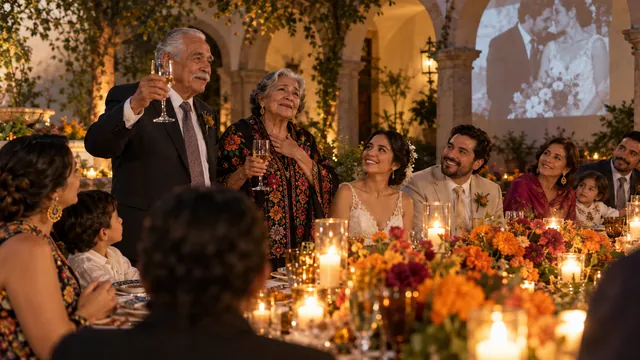
Old wedding photos of your parents and grandparents, framed or pinned on a board near the entrance. Guests love finding themselves, and it starts conversations between families who've just met.
What it takes: a few evenings digging through albums, a scanner or a good phone camera, and a board or easel. Ask a relative to help, because they'll know who everyone is.
2. The polaroid guest book wall
Guests take an instant photo, write a line on it, and clip it to a string of lights or a wire grid. By the end of the night you've got a guest book that's also a photo wall.
What it takes: an instant camera, plenty of film (more than you think), pens, clips, and someone to keep the film loaded. Film is the real cost, so set a budget and put out a little sign so it lasts.
3. The engagement photo display
Your engagement shoot, printed big. Simple, beautiful, and almost no effort on the day.
What it takes: good prints and something to hang them on. Fine on its own, though it's about the two of you, not the guests.
4. The "find your seat" photo wall
Instead of a seating chart, each guest's escort card is clipped next to a photo of them with you. It's slow to make, but people talk about it for years.
What it takes: a photo of you with nearly every guest, which is the hard part. Works best for smaller weddings.
5. The live guest photo wall
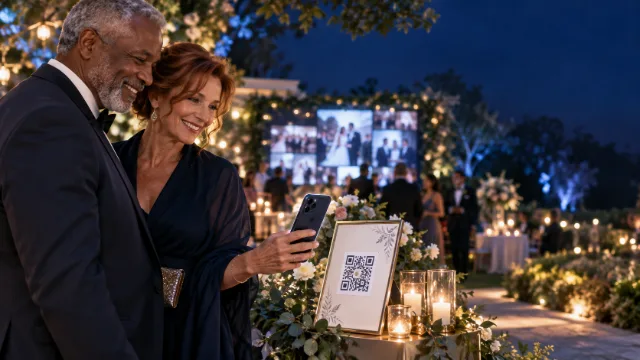
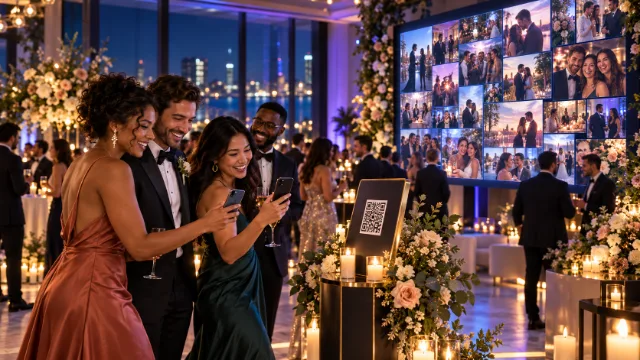
A TV, projector or LED wall at the reception showing the photos guests are taking during the wedding. Guests scan a QR code, share from their phone, and the photo appears on screen once it's approved.
This is the idea we built Pixloud around, so we're biased. What we'll say is that it does something the others can't: it shows the wedding from everyone's point of view, while it's still happening. And it collects every photo into one album for you afterwards.
What it takes: a screen (most venues have one), table cards with the QR code, and someone to approve photos. Setup takes about ten minutes once the screen is on. Your first 25 photos are free if you want to try it.
If you're doing a live wall, put the family history photos up as the first posts. The screen starts full, and older relatives love seeing them on the big screen.
6. The memorial corner
A small space with photos of loved ones who can't be there. It doesn't need to be sad. Many couples add a line like "With us in spirit" and a favorite photo.
What it takes: a few framed photos, a candle if the venue allows it, and a quiet spot away from the dance floor.
How to choose
Ask yourself what you want to look at in ten years.
- If it's your family's story, do the history wall.
- If it's handwritten notes from your friends, do the polaroid wall.
- If it's the night itself, from every table, do a live wall and keep the album.
And if you can't decide, combine them. A history wall near the entrance and a live screen in the reception room work beautifully together. One looks back. The other captures the night as it happens.
Questions people ask
What is a live wedding photo wall?
A screen at the reception that shows photos guests take during the wedding. Guests scan a QR code to share from their phones, and each photo appears once the couple or a helper approves it.
How much film do we need for a polaroid guest book?
More than you expect. Many guests take two or three shots before they get one they like, so budget for at least two photos per guest and put out a small sign asking for one each.
Can we combine a printed photo wall with a live screen?
Yes, and it works well. A printed family history wall near the entrance looks back, while a live screen in the reception shows the night as it happens.
Get every guest's photos, on the night
Guests scan a QR code and share from their phones, with no app. You approve each photo, and it plays on the big screen. Your first 25 photos are free.